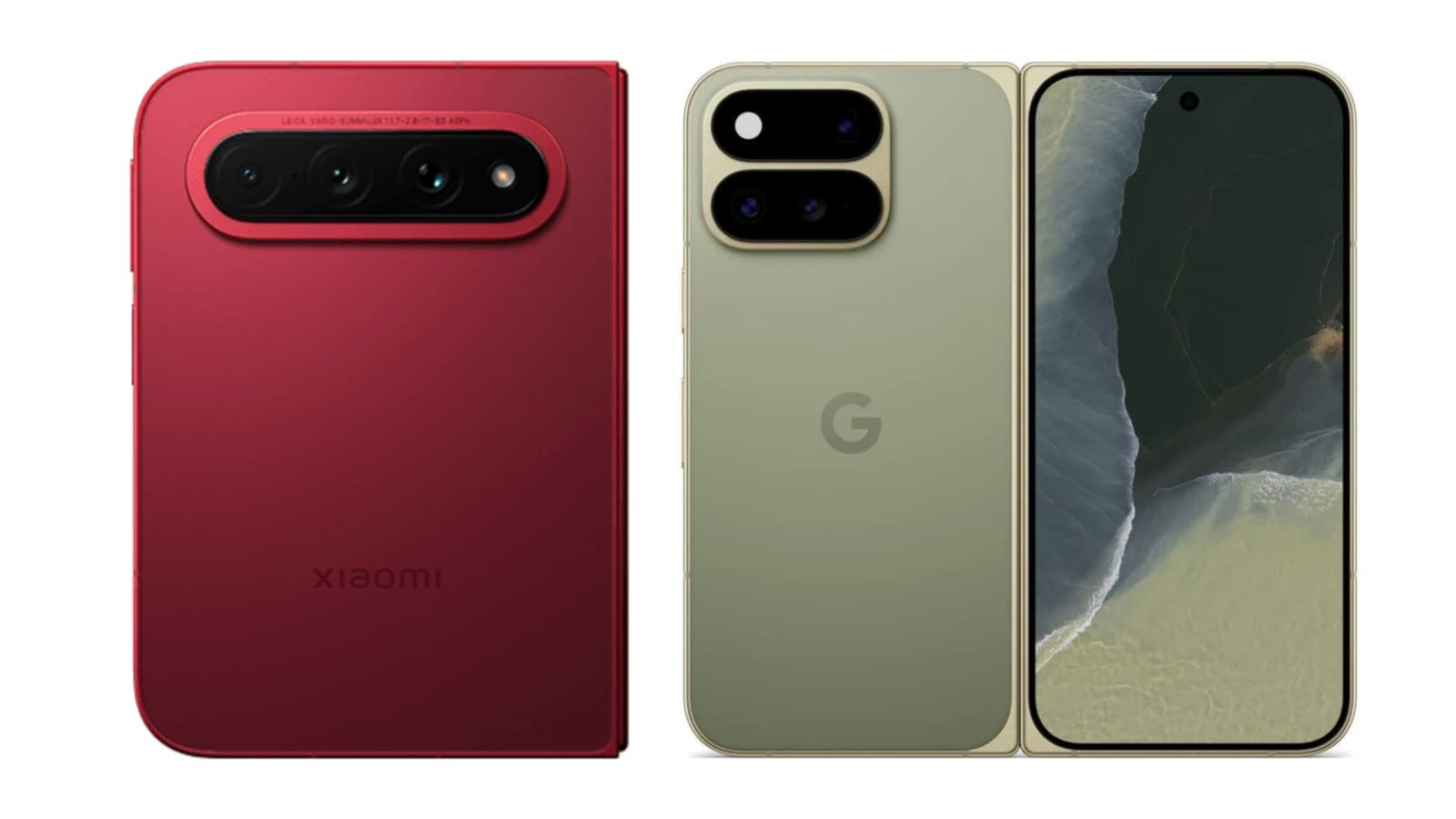

Xiaomi 18 Fold vs Google Pixel 11 Pro Fold compares two premium foldables. Both phones combine large screens with flagship hardware.
Xiaomi focuses heavily on battery, cameras, and portability. Google focuses more strongly on software and artificial intelligence.
Related Article: Redmi 17 5G Launched in China With 120Hz Display and 6,300mAh Battery
Key Takeaways:
- Xiaomi wins battery: It packs a 6,000mAh battery.
- Pixel wins software: Tensor G6 powers Google’s AI features.
- Xiaomi leads on battery and camera hardware: Its 6,000mAh battery, faster charging, and Leica-tuned camera setup stand out on paper.
Xiaomi 18 Fold vs Google Pixel 11 Pro Fold: Specifications Comparison
| Specification | Xiaomi 18 Fold | Google Pixel 11 Pro Fold |
|---|---|---|
| Cover Display | 5.38-inch AMOLED, 120Hz | 6.5-inch Super Actua OLED, 1-120Hz |
| Inner Display | 7.58-inch foldable AMOLED, 120Hz | 8-inch Super Actua Flex OLED, 1-120Hz |
| Peak Brightness | Up to 4,000 nits | Up to 3,600 nits |
| Processor | Xiaomi Xring O3 | Google Tensor G6 |
| RAM | Up to 16GB | 16GB |
| Storage | Up to 1TB | 256GB, 512GB, 1TB |
| Main Camera | 200MP Leica | 48MP |
| Telephoto | 50MP, 3.5x optical zoom | 10.8MP, 5x optical zoom |
| Ultrawide | 50MP | 10.5MP |
| Selfie Cameras | Two 16MP cameras | Two 10MP cameras |
| Battery | 6,000mAh | 4,806mAh |
| Wired Charging | 67W | 50% in about 30 minutes with 30W USB-C PPS charger or higher |
| Wireless Charging | 50W | Up to 25W Qi2.2 |
| Water/Dust Protection | IP58 + IP59 | IP68 |
| Software | HyperOS 4 based on Android 17 | Android with Gemini Intelligence |
| Starting Price | CNY 10,999 in China | ₹1,86,999 in India / $1,899 in the US |
| Availability | China; global availability not confirmed | Available internationally, including India |
Xiaomi 18 Fold vs Google Pixel 11 Pro Fold: Displays and Design
The two phones take different approaches to foldable design. Google keeps a familiar book-style foldable shape here. Xiaomi uses a wider and shorter passport-like design. This makes Xiaomi noticeably different when folded.
The Pixel 11 Pro Fold has two displays. Its external display measures 6.5 inches diagonally. The internal display measures eight inches diagonally. Both panels use OLED technology with refresh rates up to 120Hz. Google lists 3,600 nits peak brightness for both.
The Xiaomi 18 Fold uses smaller screens overall. Its cover display measures 5.38 inches diagonally. Its internal display measures 7.58 inches diagonally. Both displays support 120Hz refresh rates. They also reach up to 4,000 nits peak brightness.
Xiaomi’s inner display uses a thin-bezel design. It also features a punch-hole camera cutout. The cover display uses Xiaomi Dragon Crystal Glass 3.0. Xiaomi also uses dual-layer ultra-thin glass internally.
Google uses ultra-durable glass ceramic cover glass externally. Its inner display uses Ultra Thin Glass. The company also redesigned its foldable hinge. Google calls this its new gearless hinge design. It improves durability and crease performance.
Both phones offer water protection, but their ratings are different. Google officially lists an IP68 dust and water resistance rating. Xiaomi 18 Fold specifications list IP58 and IP59 ratings.
Display verdict: Pixel offers the larger workspace. Xiaomi offers a brighter and more compact alternative.
Related Article: How to Recover Lost Contacts from a Google Account on Android and Web
Performance and Cameras
Performance is another major comparison point here. Both phones use three-nanometer flagship processors. Google uses its custom Tensor G6 processor. Xiaomi uses its new Xring O3 processor.
The Tensor G6 focuses strongly on artificial intelligence. Google designed it around Gemini-powered experiences. The Pixel also includes 16GB RAM across configurations. Storage options include 256GB, 512GB, and 1TB.
Google’s software remains a major Pixel advantage. Gemini provides Google’s broader AI assistant experience. Circle to Search remains another useful feature. Google also adds foldable-specific multitasking improvements.
The Xiaomi Xring O3 takes a different approach. It uses a deca-core CPU design. Its fastest cores reach 4.35GHz speeds. Xiaomi also offers up to 16GB of RAM, with LPDDR6 memory available on higher-end configurations. Storage reaches up to 1TB using UFS 4.1.
Xiaomi also uses vapor-chamber cooling technology, which is designed to help manage heat during sustained workloads. Actual gaming performance will still depend on software optimization and real-world testing.
Its wider screen also supports three-app multitasking.
Camera Hardware Follows Different Strategies
Google uses an advanced triple-camera system. The main camera offers 48MP resolution. The ultrawide camera offers 10.5MP resolution. The telephoto camera offers 10.8MP resolution.
The telephoto lens supports 5x optical zoom. Super Zoom reaches up to 30x.
Google combines these cameras with strong computational photography. Features include Camera Coach, Magic Capture, Night Sight, Camera Looks, and other AI-powered photography tools.
The Pixel supports high-quality video recording capabilities. Google also emphasizes AI-powered photography throughout its software. This remains an important Pixel selling point.
Xiaomi takes a more hardware-focused camera approach. Its main camera uses a 200MP Leica-tuned sensor. The telephoto camera uses a 50MP sensor with 3.5x optical zoom. The ultrawide camera also uses a 50MP sensor.
Xiaomi also supports extended digital zoom capabilities. Video recording reaches 8K at 24fps. It can also record 4K video at 60fps. Leica tuning adds another important camera advantage.
The selfie setup differs between these phones. Pixel provides two 10MP selfie cameras, with one camera on each display. Xiaomi uses two 16MP selfie cameras instead.
Camera verdict: On paper, Xiaomi offers more aggressive camera hardware, while Pixel puts greater emphasis on computational photography and AI-powered camera features.
Battery, Charging and Price
Battery capacity strongly favors the Xiaomi 18 Fold. It packs a large 6,000mAh battery. Google uses a 4,806mAh battery instead. That gives Xiaomi a clear capacity advantage.
Xiaomi supports 67W wired charging speeds. It also supports 50W wireless charging. These specifications make Xiaomi stronger on paper for users who want faster charging.
Google says the Pixel 11 Pro Fold can reach 50% charge in about 30 minutes using a 30W USB-C PPS charger or higher. Wireless charging reaches up to 25W through Qi2.2.
Google promises more than 24 hours of battery life. However, battery performance depends heavily on usage. Xiaomi’s larger battery gives it a clear capacity advantage.
Pricing Is Now Clearer
The Xiaomi 18 Fold officially launched in China on September 7, 2026. Sales began on September 10.
Xiaomi offers the phone in several configurations:
- 12GB RAM + 256GB storage: CNY 10,999
- 12GB RAM + 512GB storage: CNY 11,999
- 16GB RAM + 512GB storage: CNY 12,999
- 16GB RAM + 1TB storage with LPDDR6: CNY 14,999
- 16GB RAM + 1TB Ceramic Special Edition: CNY 15,999
Global availability remains an important unanswered question. Xiaomi has not yet confirmed an India launch.
The Pixel 11 Pro Fold starts at ₹1,86,999 in India. Google’s US pricing starts at $1,899 before trade-in offers.
Storage choices include 256GB, 512GB, and 1TB. Every configuration includes 16GB RAM.
Availability creates another important difference between them. Xiaomi has currently launched the 18 Fold in China, while the Pixel 11 Pro Fold already has official international availability.
The End Note
Xiaomi delivers a bigger battery and faster charging. Its Leica camera hardware also looks highly competitive.
Pixel remains stronger for Google’s software ecosystem, Gemini features, international availability, and longer software support.
Choose the Xiaomi 18 Fold if battery capacity, charging speed, compact foldable design, and camera hardware matter most.
Choose the Pixel 11 Pro Fold if you prefer Google’s AI features, software experience, stronger global availability, and long-term update support.
Overall, the better choice depends mainly on whether you value stronger hardware or Google’s software and AI ecosystem.